



How Educational Robotics Makes Coding Easier for Young Children

Many parents recognize the importance of coding and digital literacy, but they often wonder whether coding is too abstract for young children. After all, traditional programming involves typing commands, understanding syntax, and working with concepts that cannot be physically seen or touched.
For children aged 4–9, abstract concepts can be challenging to understand. Young learners typically learn best through concrete experiences, experimentation, and hands-on activities. This is why educational robotics has become one of the most effective ways to introduce coding to children.
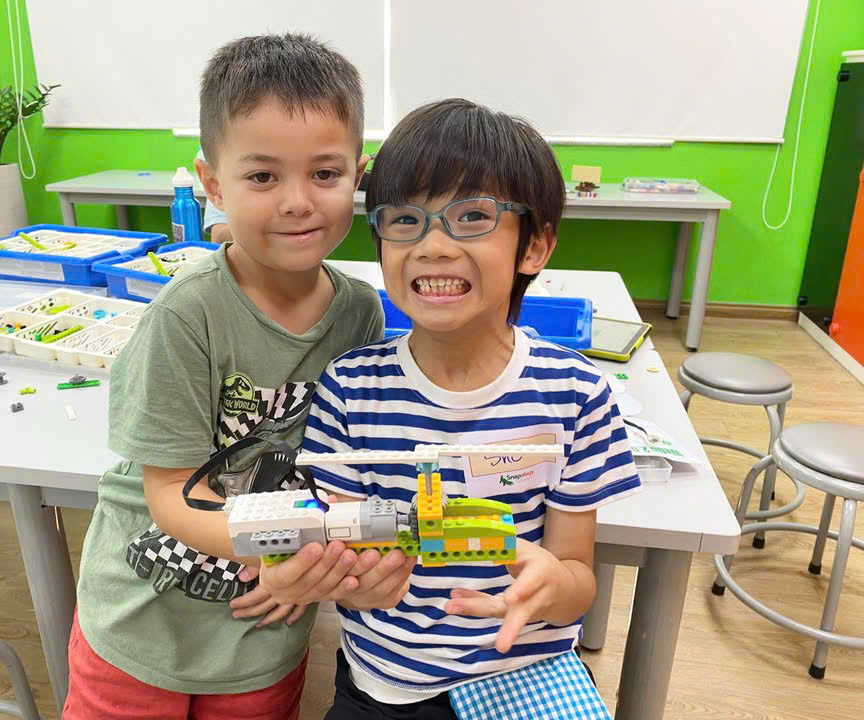
Educational robotics transforms coding from an abstract screen-based activity into a meaningful physical experience. Instead of simply watching instructions appear on a computer screen, children can build, program, test, and observe real-world outcomes. Robotics makes abstract concepts visible and helps children connect their ideas with tangible results.
Learning happens through experimentation. Through educational robotics, children develop problem-solving, creativity, computational thinking, and confidence while engaging in playful, hands-on learning experiences.
At STEAMology, educational robotics serves as a foundation for helping children aged 4–9 discover coding through creativity, exploration, and project-based learning.

Why Is Coding Difficult for Young Children?
Coding can be difficult for young children because many programming concepts are abstract and invisible. Traditional coding often requires children to understand symbols, syntax, and logical relationships that they cannot physically see or manipulate.
Young children learn primarily through direct experience. They understand concepts more easily when they can touch, move, observe, and experiment with objects in their environment.
Traditional programming presents several challenges for early learners:
Abstract symbols
Text-based instructions
Invisible processes
Delayed feedback
Complex logical structures
For example, when a child writes code on a computer screen, the connection between the instruction and the outcome may not always feel intuitive.
Coding teaches children how to think. However, before children can think abstractly, they often need concrete experiences that help them build understanding gradually.
Developmental psychology research suggests that young learners benefit significantly from experiences that involve physical interaction and visual feedback. Imagine asking a five-year-old child to understand a loop command in a traditional programming language. Without visual support, the concept may seem confusing.
However, if the child watches a robot repeat the same movement several times after programming a repeat block, the concept immediately becomes understandable.
Key Takeaway
Young children learn coding more effectively when abstract ideas become visible, physical, and interactive.
How Does Educational Robotics Make Coding More Understandable?
Educational robotics makes coding easier by transforming abstract programming concepts into concrete, hands-on experiences that children can observe, manipulate, and understand.
Educational robotics combines physical interaction with computational thinking.
Instead of imagining what code does, children can see their instructions produce real-world actions. This immediate connection helps children build understanding naturally. Robotics supports learning by providing:
Physical interaction
Visual feedback
Immediate results
Active experimentation
Creative exploration
Robotics makes abstract concepts visible. When children build and program robots, they experience coding as a process of creating, testing, and improving solutions rather than memorizing rules.
Learning happens through experimentation. Every test provides valuable information that helps children refine their understanding. Educational robotics also encourages curiosity. Children naturally ask questions such as:
What happens if I change this instruction?
Why did the robot move differently?
How can I improve my design?
Innovation begins with curiosity.
A child builds a simple robot car using LEGO Education SPIKE. After programming the robot to move forward, the child notices that the robot travels too far.
The child modifies the timing block, tests again, and adjusts the program until the desired result is achieved. This process helps the child understand sequencing, measurement, and cause and effect. Educational robotics helps children understand coding by allowing them to see and interact with their ideas directly.
Why Does Seeing Cause and Effect Help Children Learn Coding?
Understanding cause and effect helps children learn coding because it allows them to connect their actions with immediate outcomes, making abstract concepts easier to understand and remember.
Cause-and-effect relationships form the foundation of computational thinking.
When children program a robot, they learn that:
Instructions produce actions
Actions produce results
Results provide feedback
Feedback supports improvement
Testing supports learning. This process encourages children to think systematically and develop problem-solving strategies.
Experience strengthens memory because children actively participate in discovering relationships rather than simply receiving information.
When children observe a robot responding to their instructions, they develop a deeper understanding of:
Sequencing
Logic
Prediction
Debugging
Problem-solving
Problem-solving develops through practice. A child programs a Micro:bit device to display a smiley face when a button is pressed.
The child presses the button and immediately observes the result. If the program does not behave as expected, the child modifies the instructions and tests again.
This cycle of experimentation strengthens learning.
Immediate feedback helps children understand that coding is a process of testing, learning, and improving.

How Does Hands-On Learning Improve Coding Education?
Hands-on learning improves coding education by increasing engagement, strengthening understanding, supporting memory retention, and building confidence through active participation.
Young children learn best when they are actively involved in the learning process.
Hands-on learning supports:
Attention
Motivation
Understanding
Memory
Creativity
Confidence
Children remember experiences more effectively than verbal explanations alone.
Hands-on learning improves understanding because children physically interact with concepts and receive immediate feedback.
Confidence grows through practice. As children solve problems and overcome challenges, they develop greater confidence in their abilities.
Hands-on learning also encourages persistence. Children learn that mistakes are valuable opportunities for growth. Creativity drives innovation. Through building and experimentation, children discover multiple ways to solve problems.
A child designs a robot that can transport small objects. After several unsuccessful attempts, the child redesigns the robot, adjusts the program, and eventually succeeds. This process develops both technical understanding and resilience.
Hands-on learning creates meaningful experiences that improve understanding, retention, and confidence.
How Do LEGO Education SPIKE and Micro:bit Support Coding Education?
LEGO Education SPIKE and Micro:bit support coding education by combining physical computing, visual programming, experimentation, and creative problem-solving. Educational tools are most effective when they allow children to create meaningful projects.
LEGO Education SPIKE
LEGO Education SPIKE combines:
Building
Engineering
Coding
Sensors
Motors
Creative problem-solving
Children can build robots, vehicles, machines, and interactive systems while learning programming concepts through visual coding.
Micro:bit
Micro:bit introduces children to physical computing through:
Sensors
Buttons
Displays
Sound
Motion detection
Interactive programming
Micro:bit allows children to create projects that interact with the real world.
Learning happens through experimentation. Children test ideas, observe outcomes, and improve their designs through repeated practice. Using LEGO Education SPIKE, children might build a robotic amusement park ride.
Using Micro:bit, children might create:
Step counters
Reaction games
Temperature monitors
Interactive devices
These projects connect coding with real-world experiences.
Key Takeaway
LEGO Education SPIKE and Micro:bit help children learn coding by making technology interactive, creative, and meaningful.
What Skills Do Children Develop Through Educational Robotics?
Educational robotics helps children develop computational thinking, creativity, problem-solving, collaboration, communication, engineering thinking, and confidence. The purpose of educational robotics is not simply to teach coding.
Instead, robotics supports the development of essential lifelong skills.
Computational Thinking
Children learn to break complex problems into manageable steps.
Creativity
Children imagine, design, build, and improve original ideas.
Problem-Solving
Children identify challenges and develop solutions through experimentation.
Engineering Thinking
Children explore design, testing, optimization, and iteration.
Communication
Children explain their ideas and share their discoveries.
Collaboration
Children work together to solve challenges and build projects.
Confidence
Confidence grows through practice and successful problem-solving experiences.
Design thinking begins with empathy. Children learn to create solutions that address real-world needs and human experience.
A group of children designing an automated recycling robot learns to:
Plan ideas
Build prototypes
Test solutions
Analyze results
Collaborate effectively
Present their findings
This process integrates multiple academic and life skills simultaneously.
Key Takeaway
Conclusion
Coding can be challenging for young children when concepts remain abstract and disconnected from their everyday experiences. Educational robotics addresses this challenge by transforming coding into a physical, interactive, and meaningful learning experience.
Robotics makes abstract concepts visible. Through hands-on learning, children can build, program, test, and improve their ideas while developing creativity, computational thinking, and problem-solving skills.
Learning happens through experimentation. Educational robotics encourages children to explore, ask questions, test solutions, and learn from their experiences. These processes help build understanding, confidence, and resilience.
At STEAMology, educational robotics serves as a powerful tool for helping children aged 4–9 discover coding through creativity, hands-on projects, and meaningful exploration. By combining LEGO Education SPIKE, Micro:bit, and project-based learning experiences, STEAMology helps children develop the skills and confidence needed to become creative problem-solvers and lifelong learners.
FAQ Section
What is educational robotics?
Educational robotics is a learning approach that uses programmable robots to teach coding, engineering, problem-solving, and computational thinking through hands-on experiences.
Can preschool children learn robotics?
Yes. Children as young as four years old can learn age-appropriate robotics concepts through visual programming, building activities, and guided experimentation.
Why is robotics effective for learning coding?
Robotics makes abstract coding concepts visible and interactive, helping children understand programming through physical experiences and immediate feedback.
Is robotics easier than traditional coding?
For young children, robotics is often easier because it combines visual programming with physical interaction and hands-on learning.
How does LEGO Education SPIKE teach coding?
LEGO Education SPIKE teaches coding through building projects, visual programming, sensors, motors, and hands-on experimentation.
How does Micro:bit support computational thinking?
Micro:bit encourages children to create interactive projects that involve sequencing, logic, problem-solving, and experimentation.
Why is hands-on learning important in STEAM education?
Hands-on learning improves engagement, understanding, memory retention, and confidence by allowing children to actively participate in learning.
What skills do children develop through educational robotics?
Children develop computational thinking, creativity, communication, collaboration, engineering skills, problem-solving abilities, and confidence.


Comments