



From Robotics to STEAM Careers at Starlink (SPACEX): How Robotics Education Can Shape a Child’s Learning Pathway

A child may begin by building a simple LEGO robot.
At first, the goal might be nothing more than making it move forward, turn, follow a line, or complete a challenge. But that small project can lead to much bigger questions: How does this work? Why did it fail? Can I make it better? What happens if I change the code?
Years later, that same curiosity might lead a student toward coding, engineering, electronics, computer science, manufacturing, product design, data or another field entirely.
That does not mean every child who learns robotics will become an engineer.
Instead, robotics education for kids can serve as an early doorway to curiosity, experimentation, problem-solving, and a broader STEAM learning pathway.
A real-world example makes that pathway easier to understand. SpaceX currently lists a Supplier Development Engineer (Starlink) position in Hanoi. The role involves areas such as supplier development, manufacturing, testing, quality and production, and its qualifications include a bachelor's degree in engineering or another STEM discipline.
A child building a robot today is not preparing directly for that specific job.
But the experience of asking questions, testing ideas, finding problems and improving a design reflects a much broader way of thinking that appears throughout engineering and technology.

How Can a Simple Robotics Project Become Part of a Bigger Learning Journey?
A robotics project can connect hands-on building with coding, mathematics, science, engineering, and design. More importantly, it gives children a practical environment in which they can ask questions, test ideas, identify problems and improve their solutions.
Robotics makes abstract concepts visible. A child does not simply learn that an instruction has a sequence. They can write the instructions and watch a robot respond. They do not just hear about cause and effect. They can change a sensor value and see what happens.
They do not simply learn that mistakes are part of learning. They experience a robot failing to complete a task and have to figure out why. This is one reason educational robotics can work well within hands-on learning and project-based learning environments.
Recent research supports the broader educational value of robotics. A 2026 three-level meta-analysis synthesizing 58 studies and 5,806 students found positive overall effects of educational robotics on learning outcomes, including cognitive and affective outcomes.
A seven-year-old wants to make a robot reach a target. The robot stops too early.
Instead of simply being told the correct answer, the child experiments: change the code, move the sensor, test again and observe the result.
That small cycle introduces a powerful learning habit:
Build → Test → Observe → Debug → Improve.

What Skills Can Children Develop Through Educational Robotics?
Educational robotics can give children repeated opportunities to practice problem-solving, computational thinking, logical reasoning, creativity, debugging, persistence, collaboration and communication.
The most valuable part of robotics may not be the robot itself.
It may be what happens when the robot does not work. Children have to break a problem into smaller parts, identify possible causes, test solutions and decide what to change next. This is closely connected with computational thinking and engineering-style problem-solving.
A 2024 systematic review and meta-analysis of coding interventions involving children ages 4–16 found that coding activities produced the strongest effects on problem-solving, while also supporting planning and other executive functions.
Another 2024 meta-analysis specifically examining robot-supported learning found medium effects on computational thinking overall, with benefits across computational-thinking concepts, practices and perspectives.
These findings do not mean that every robotics class automatically produces these skills. The learning design matters. Children need meaningful challenges, opportunities to experiment and enough support to reflect on what they are doing.
A team is building a robot that must navigate a course.
One student focuses on the code. Another examines the mechanical design. A third records what happens during testing.
They must communicate, compare observations and agree on what to change.
Robotics gives children a place to practice transferable ways of thinking—not just robotics-specific skills.
How Can STEAM Education Connect to Future STEM Pathways?
STEAM education can expose children to different ways of thinking and creating before they have to choose a specific academic or career direction. Robotics can connect science, technology, engineering, mathematics, creativity and design in one practical learning experience.
There is an important distinction between a STEAM learning experience and a STEM career pathway.
STEAM education is about exploration and integration.
A future STEM pathway may eventually involve advanced mathematics, science courses, technical education, university study, research, internships, or professional experience. A child does not need to decide at age eight whether they want to become a mechanical engineer. Instead, early experiences can help them discover:
Do I enjoy building things?
Do I like solving technical problems?
Do I enjoy coding?
Do I prefer designing?
Do I enjoy working with data?
Do I like explaining ideas to other people?
Those discoveries can influence future choices without determining them.
A student who loves designing robot mechanisms may later become interested in mechanical engineering. Another student who enjoys writing programs may explore computer science.
A third may discover that they enjoy presenting ideas and leading a team more than either. All three outcomes are valuable.
STEAM education helps children discover possibilities before they have to choose a destination.
What Can SpaceX and Starlink Teach Us About Real-World STEM Skills?
Real-world technology roles often require much more than coding. Engineering and technology teams may rely on technical knowledge, experimentation, manufacturing, testing, quality improvement, data analysis, communication and continuous problem-solving.
The SpaceX Supplier Development Engineer (Starlink) role in Hanoi provides a useful real-world example. The current posting describes responsibilities connected with supplier development, manufacturing, testing, quality, reliability and production, and lists a bachelor's degree in engineering or a STEM field among its basic qualifications.
The broader lesson is more important than the company name.
Modern technology is built through many different disciplines and roles.
A sophisticated product requires people who can:
understand technical systems
analyse problems
test assumptions
work with data
improve manufacturing processes
maintain quality
collaborate across teams
keep learning as technology changes
That is much broader than simply knowing how to code.
Imagine a child asking why a robot keeps turning too far.
They test the motor, inspect the code, measure the movement and adjust the design.
That is obviously not the same as professional engineering.
But the underlying habit—ask, test, analyse, improve—can become increasingly sophisticated as a learner grows.
The goal of early robotics is not to prepare children for one company; it is to help them develop habits of thinking that can grow with them.

Does Learning Robotics Mean a Child Will Become an Engineer?
Direct Answer: No. Robotics does not determine a child's future career. It can, however, help children discover whether they enjoy building, designing, coding, experimenting and solving problems.
Children's interests change. A child who loves robotics at eight may discover physics at twelve, computer science at fourteen or an entirely different passion later. That is not a failure of the robotics journey.
It is the point of exploration. Early education should give children opportunities to discover what they enjoy rather than forcing them into a predetermined career identity. Robotics can also develop skills that remain useful even when a child leaves robotics behind. Communication, collaboration, creativity, persistence and problem-solving are not limited to engineering.
A child may discover that they dislike programming but love designing the appearance and structure of a robot. That could lead toward design rather than software. Another child may enjoy explaining the team's solution and presenting the project. Their strongest interest might eventually be communication or leadership.
Robotics should help children explore who they are as learners—not tell them who they must become.
What Does a Long-Term Robotics Learning Pathway Look Like?
Direct Answer: A robotics learning pathway can gradually move from exploration to creation, application, deeper study and new opportunities. The pathway is flexible, and children may enter, leave or change direction at different stages.
A Possible Pathway
Stage 1 — Explore
Children play, build, experiment and discover how simple systems work.
Stage 2 — Create
Children begin designing their own solutions and using age-appropriate coding and robotics tools.
Stage 3 — Apply
Children work on larger projects, challenges and collaborative experiences. Programs such as FIRST LEGO League provide age-based experiences that include Discover, Explore and Challenge divisions, depending on the child's age and local program structure.
Stage 4 — Deepen
Older students may explore engineering, computer science, electronics, manufacturing, science, mathematics or product design in greater depth.
Stage 5 — Discover New Opportunities
Later educational experiences may include university projects, competitions, internships, research or professional work.
The pathway is not a checklist.
A child might stop robotics and return to it later. They might move from robotics into coding. They might discover design. They might pursue something unrelated.
A child begins with a simple building activity at age six, joins a project-based robotics program later, becomes interested in programming at twelve, and eventually chooses computer science. Another child follows the same early experience but eventually chooses architecture. Both journeys can be successful.
A strong robotics pathway grows with the child instead of forcing every child toward the same destination.
Why Should Parents Focus on the Learning Journey Instead of the Job?
Young children do not need to choose a career decades in advance. The purpose of early STEAM education is to help children explore, experiment, develop confidence and discover interests that may inform later educational choices.
Parents naturally want to prepare their children for the future.
But future careers are changing, and children themselves are changing as they learn. The more useful question may not be: “What job will this activity prepare my child for?”
It may be:
What kind of learner is my child becoming through this experience?
Is the child becoming more willing to ask questions?
More comfortable with mistakes?
More confident in testing an idea?
Better at explaining a solution?
More curious about how technology works?
These are meaningful outcomes even when the final career remains unknown.
A child spends an afternoon trying to fix a robot that refuses to follow a line. They do not solve it immediately. But they keep testing different ideas until something works. That persistence may matter far beyond robotics.
How Does Hands-On Learning Make Robotics More Meaningful for Children?
Hands-on learning gives children opportunities to connect ideas with physical actions and visible results. Robotics makes this especially clear because children can immediately see what happens when they change a design, instruction or strategy.
A textbook can explain how a sensor works.
A robotics project lets a child use one.
A teacher can explain debugging.
A robot that refuses to move gives the child a real debugging problem.
This does not mean hands-on learning is automatically better than every other teaching method. The quality of the activity, instructional support and learning objectives still matter.
Recent research suggests educational robots are most useful when they are embedded in structured, sustained learning experiences rather than used simply as short demonstrations. A 2026 meta-analysis of physically embodied educational robots found moderate positive effects on learning outcomes and stronger effects in structured, active learning contexts.
Instead of giving children the correct code immediately, a teacher asks: “What do you think caused the robot to stop?” The children make predictions, test them and explain what they discovered.
How Can STEAMology Support a Child’s Long-Term Curiosity?
STEAMology can provide a place for children to explore robotics, coding and STEAM through hands-on learning, project-based activities, collaboration and age-appropriate challenges without requiring them to commit to a future career.
A meaningful STEAM environment should leave room for questions.
Instead of focusing only on whether a child completed the “correct” build, educators can encourage children to ask:
What happens if I change this?
Why did it fail?
Is there another way?
How could we make it better?
How would we explain our solution?
That approach treats robotics as a learning experience rather than simply a technical activity. For STEAMology, the larger goal is not to predict whether a child will become an engineer, programmer or technology professional.
It is to create opportunities for children to discover how they like to think, create and solve problems.
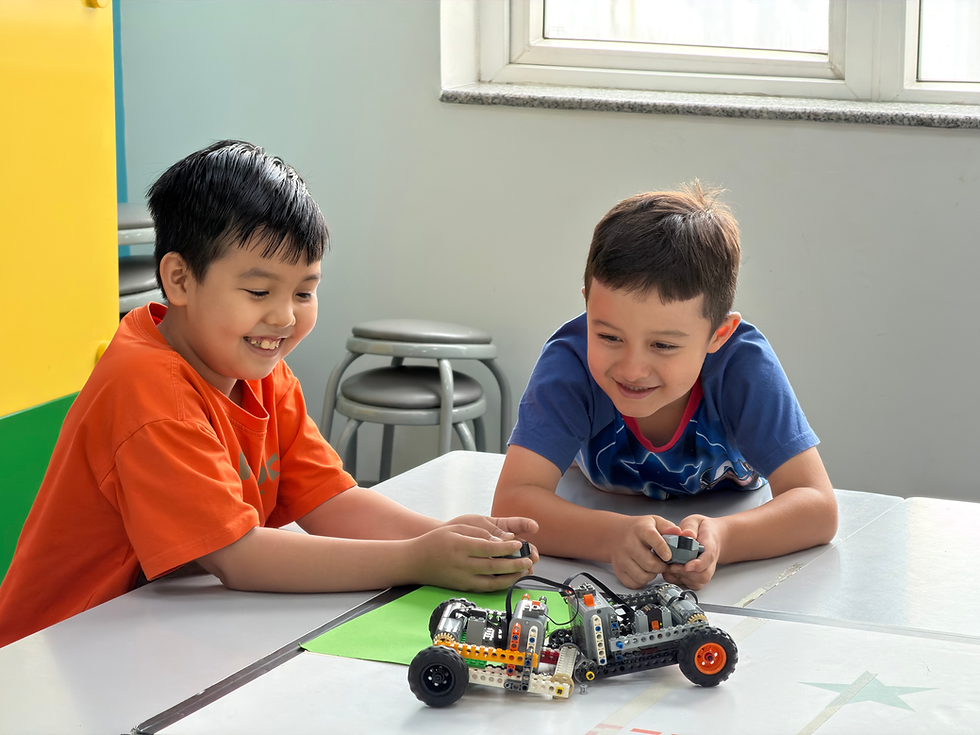
Today, a child may build a LEGO robot. Tomorrow, they may experiment with coding. Years later, they may choose engineering, computer science, design, science—or something completely different.
Conclusion
A child building a robot today may eventually choose engineering.
Or computer science.
Or product design.
Or manufacturing.
Or research.
Or a completely different field.
That uncertainty is not a weakness of STEAM education. It is one of its strengths.
The purpose of robotics education for kids is not to predict a child's career. It is to give children meaningful opportunities to explore how they think, create, collaborate and solve problems. The world of Starlink and advanced technology offers a useful reminder of where deep STEM learning can eventually lead. Real engineering roles require technical knowledge, experience, testing, analysis, collaboration and continuous learning. But no child needs to think about a specific job at the beginning of that journey. They can simply start with a question:
“Why doesn't this work?”
Then:
“What can I change?”
And eventually:
“What can I build?”
Frequently Asked Question (FAQ)
1. Can learning robotics help children prepare for STEM?
Yes, robotics can give children practical opportunities to explore STEM concepts through building, coding, testing and problem-solving. Research suggests educational robotics can support computational thinking, particularly when activities are structured around meaningful problems and experimentation. However, robotics should be viewed as one learning experience, not a guarantee of future STEM study or employment.
2. Does robotics lead to an engineering career?
Not necessarily. Robotics can help children discover whether they enjoy designing, building, coding and solving technical problems, which may later connect with engineering or other STEM fields. A child's eventual career depends on many later experiences, interests and educational choices. Robotics is better understood as an exploration opportunity than a predetermined career pathway.
3. What skills do children develop through educational robotics?
Educational robotics can provide practice in problem-solving, computational thinking, logical reasoning, debugging, creativity, persistence, collaboration and communication. The exact outcomes depend on the curriculum and learning environment. Research has found positive relationships between structured robotics or coding activities and areas such as computational thinking and problem-solving.
4. What is a STEM learning pathway?
A STEM learning pathway is the progression through experiences and education related to science, technology, engineering and mathematics. For a child, it might begin with playful exploration, continue through robotics or coding projects, and later include advanced school subjects, university study, research or technical work. There is no single correct STEM pathway.
5. Can STEAM education help children explore future careers?
Yes. STEAM education can expose children to different ways of creating, analysing and solving problems before they need to choose a specific academic or professional direction. It can help children notice what they enjoy — such as coding, design, experimentation or teamwork — while keeping future options open.
6. Do children need to know coding before learning robotics?
No. Many educational robotics activities introduce coding gradually. Younger children may begin with sequencing, movement or visual programming before progressing to more complex code. The goal is not to make children master programming immediately, but to help them understand that instructions can control a system and that problems can be solved through testing and iteration.
7. At what age can children start exploring STEM?
There is no single starting age. Age-appropriate STEM exploration can begin in early childhood through play, building, stories and simple experiments. For example, FIRST LEGO League currently offers Discover for ages 4–6, Explore for 6–10 and Challenge for 9–16, with age ranges varying by country.
8. Why are hands-on STEAM experiences important?
Hands-on learning allows children to connect abstract ideas with something they can build, observe and change. In robotics, children can immediately see whether a design or program works, making experimentation and debugging tangible. This can support deeper engagement and provide practical opportunities to develop computational thinking and problem-solving.


Comments